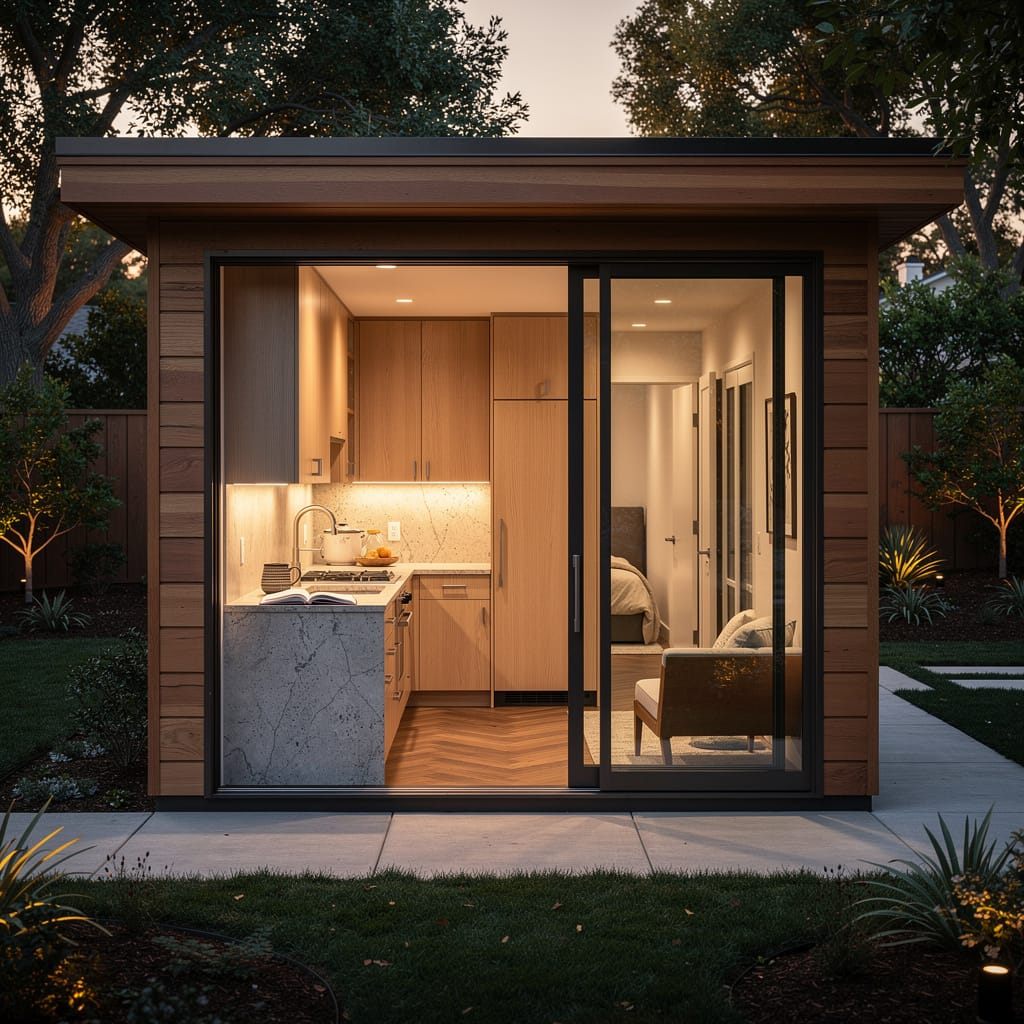
What Is an ADU in California and Why Are Homeowners Building Them in 2026?
An ADU in California — short for Accessory Dwelling Unit — is a secondary residential unit built on a single-family lot. It has its own entrance, kitchen, bathroom, and sleeping area, and it can be attached to your primary home, detached in your backyard, or converted from an existing structure like a garage. Under California law (Government Code Sections 65852.2 and 65852.22), every homeowner with a single-family or multifamily property has the right to build at least one ADU, and cities cannot prohibit them.
Having built over 116 projects across the Bay Area and Silicon Valley, I've watched ADU construction evolve from a niche permit headache into one of the smartest investments a homeowner can make. I'm Bar Benbenisty, founder of Barcci Builders (CA Contractor License #1086047), and my team has designed and built ADUs in Los Gatos, Saratoga, Palo Alto, Cupertino, and dozens of other Bay Area cities. This guide distills everything I tell homeowners during their first consultation — the real costs, the timelines that actually hold up, the design decisions that matter, and the 2026 California ADU laws you need to understand before breaking ground.
Why the surge in ADU construction right now? Three forces are converging in 2026:
- State legislation keeps getting friendlier. AB 1033 (effective 2024) allows cities to permit ADUs to be sold as condominiums — separate from the primary home. AB 976 made the removal of owner-occupancy requirements permanent. SB 897 increased height limits to 18 feet for detached ADUs (and 25 feet in some cases near transit).
- Bay Area property values make the math irresistible. A well-designed ADU in Los Gatos or Los Altos can generate $3,500–$5,500/month in rental income, and the construction cost is a fraction of buying a second property.
- Multigenerational living is the new normal. Aging parents, adult children returning from college, or a live-in caregiver — ADUs solve real family needs without sacrificing privacy.
Whether you call it a granny flat, a backyard cottage, an in-law unit, or a casita, the legal term is the same: Accessory Dwelling Unit. And in California in 2026, building one is more accessible — and more valuable — than ever before.
What Are the Different Types of ADUs Allowed in California?
Not every ADU looks the same, and the type you choose has a major impact on cost, timeline, and how much usable space you end up with. California recognizes several distinct ADU categories, and understanding the differences is the first design decision you'll make.
| ADU Type | Description | Typical Size (Bay Area) | Estimated Cost Range (2026) | Timeline (Design to Move-In) |
|---|---|---|---|---|
| Detached ADU | Standalone structure in the backyard, fully independent from the main home | 400–1,200 sq ft | $285,000–$550,000+ | 8–14 months |
| Attached ADU | Built as an addition to the existing house, sharing at least one wall | 300–1,000 sq ft | $250,000–$475,000 | 7–12 months |
| Garage Conversion ADU | Existing garage converted into a livable unit (no new foundation in most cases) | 250–600 sq ft | $150,000–$300,000 | 5–9 months |
| Above-Garage ADU | New living space built on top of an existing or new garage | 400–800 sq ft | $300,000–$500,000 | 9–14 months |
| Interior Conversion (Junior ADU) | Converting existing space within the home (e.g., basement, large bedroom) into a JADU up to 500 sq ft | 200–500 sq ft | $80,000–$180,000 | 3–6 months |
A few critical notes from our project experience:
- Detached ADUs are the most popular choice in Los Altos, Menlo Park, and Saratoga because lot sizes are generous (often 10,000+ sq ft) and homeowners want a fully private unit — sometimes for rental income, sometimes as a home office or guest suite.
- Garage conversions are the most budget-friendly option and work exceptionally well in cities like Campbell, Sunnyvale, and San Jose where two-car garages are common but underused.
- Junior ADUs (JADUs) are capped at 500 sq ft by California law and must be created within the existing footprint of the primary home. The beauty is that you can build both a JADU and a full ADU on the same single-family lot — giving you up to three units total.
- Above-garage ADUs require structural engineering to verify (or upgrade) the existing garage foundation and framing. Our team works with structural engineers early in 3D design and rendering to confirm feasibility before a single permit application is filed.
California state law now allows ADUs up to 1,200 square feet for new detached units (or 1,000 sq ft for one-bedroom units and 850 sq ft for studios), though many Bay Area cities have adopted the maximum allowance. Height limits vary: 16 feet for single-story detached, 18 feet in most cases, and up to 25 feet if within half a mile of a major transit stop — relevant for parts of Mountain View, Sunnyvale, and San Jose near Caltrain and VTA stations.
How Much Does It Cost to Build an ADU in the Bay Area in 2026?
This is the question I hear most, and I want to give you numbers based on real projects — not national averages that have no relevance to Silicon Valley construction costs. The cost to build an ADU in the Bay Area in 2026 depends on five primary factors: unit type, size, site conditions, finishes, and permit fees.
Here's what we're seeing across our active projects:
Cost Per Square Foot Breakdown
- Garage conversion ADU: $350–$500 per square foot
- Attached ADU (addition): $400–$550 per square foot
- Detached new-construction ADU: $425–$600+ per square foot
- High-end / luxury ADU with premium finishes: $550–$750+ per square foot
These ranges include design, engineering, permits, construction, and basic landscaping. They do not include furniture, extensive outdoor hardscaping, or separate utility meters (which some homeowners add at $5,000–$15,000).
What Drives the Cost Higher?
In my experience, these are the biggest cost escalators for ADU construction in Silicon Valley:
- Sloped lots. Many properties in Los Gatos, Saratoga, and the foothills communities require retaining walls, engineered foundations, and grading — easily adding $40,000–$80,000.
- Sewer lateral upgrades. Older homes (especially pre-1970s) in Palo Alto, Menlo Park, and Redwood City may need a new sewer connection, running $8,000–$25,000 depending on distance to the main.
- Premium finishes. Our clients increasingly request the same level of finish in their ADU as their main home. We're installing Dekton Kreta countertops, rift-cut white oak cabinetry, zellige tile backsplashes, unlacquered brass fixtures by Waterworks, and herringbone white oak flooring in ADUs that rival luxury primary residences.
- Permit and impact fees. While California has waived impact fees for ADUs under 750 sq ft (through 2025 legislation, extended in many jurisdictions), larger units may still trigger school district fees, park fees, and water/sewer connection charges. In Santa Clara County, these can total $5,000–$30,000 depending on the city and unit size.
The good news: California law prohibits cities from charging impact fees on ADUs under 750 sq ft, and the fee structure for larger ADUs must be proportional — not the same as a new single-family home. This was a major barrier that the state legislature systematically removed.
Real Project Cost Example
We recently completed a 750 sq ft detached ADU in Los Gatos with one bedroom, one bathroom, an open kitchen-living area, and a covered patio. The specifications included microcement bathroom walls, a plaster range hood, Thermador induction cooktop, Miele compact appliances, Calacatta Viola marble vanity top, cedar cladding on the exterior, and natural stone veneer accent walls. Total project cost: $412,000 — inclusive of design, permits, construction, and site work. That's approximately $549 per square foot for a unit that now appraises at over $650,000 in added property value.
What Is the ADU Permit Process in California and How Long Does It Take?
The ADU permit process in California follows a streamlined path mandated by state law, but in practice, every Bay Area city interprets "streamlined" a bit differently. Here's the real-world process our team navigates for every project:
Step 1: Feasibility and Site Assessment (1–2 Weeks)
Before we draw a single line, we assess your lot for setback compliance, utility access, soil conditions, and tree protection (especially in Los Gatos and Saratoga, where heritage oak ordinances can dictate where you build). We also pull your property's zoning and parcel data to confirm ADU eligibility — though in California, this is almost universally guaranteed for single-family lots.
Step 2: Design and Engineering (4–8 Weeks)
Our 3D design rendering process lets you walk through your ADU virtually before construction begins. This phase includes architectural plans, structural engineering, Title 24 energy compliance, and (for some cities) a preliminary fire sprinkler plan. We design to your lifestyle first, then optimize for the permit reviewer's checklist — not the other way around.
Step 3: Permit Submission and Review (4–8 Weeks)
California law requires cities to approve or deny ADU permits within 60 days of receiving a complete application. In practice:
- Los Gatos: Generally 4–6 weeks for plan review, with the Town's Community Development Department being responsive and predictable.
- Palo Alto: Often closer to 6–8 weeks. The city requires detailed stormwater management plans and strict setback verification.
- San Jose: The planning department has significantly improved processing times — often 4–5 weeks — largely due to their Pre-Approved ADU Plan program.
- Saratoga / Monte Sereno: Smaller cities with fewer staff can sometimes take the full 60 days. Monte Sereno in particular has additional design review requirements.
- San Mateo County cities (San Mateo, Burlingame, Hillsborough): Permit timelines vary more widely. Hillsborough's architectural review process can add 2–4 weeks.
Step 4: Construction (12–28 Weeks)
A garage conversion can be completed in as little as 12–16 weeks. A new detached ADU typically takes 20–28 weeks, depending on complexity. Our team manages every inspection — foundation, framing, rough plumbing/electrical/mechanical, insulation, drywall, and final — to keep the project moving without gaps.
Step 5: Final Inspection and Certificate of Occupancy (1–2 Weeks)
Once the city inspector signs off, you receive your Certificate of Occupancy and the unit is legally habitable. Total timeline from first consultation to move-in: typically 8–14 months for a detached ADU, or 5–9 months for a garage conversion.
One important tip: don't wait until you have "perfect" plans to start the conversation. The earlier you involve an experienced ADU builder in the Bay Area, the fewer surprises you'll encounter during permitting and construction.
ADU vs. Home Addition vs. Guest House: Which Is Right for Your Property?
Homeowners frequently ask me whether they should build an ADU or simply add a room to their existing home. The answer depends on your goals, your lot, and your budget. Here's an honest comparison:
| Feature | ADU (Accessory Dwelling Unit) | Home Addition | Guest House (Non-ADU) |
|---|---|---|---|
| Independent kitchen? | Yes — full kitchen required | No (shared with main home) | Usually no (many cities prohibit kitchens in guest houses) |
| Can be rented? | Yes — legally | No (it's part of the primary residence) | Generally no |
| Can be sold separately? | Yes — under AB 1033, if your city opts in | No | No |
| Permit pathway | Streamlined (state-mandated 60-day review) | Standard building permit (timeline varies) | Standard building permit, often more restrictions |
| Setback requirements | 4 ft rear/side for detached ADU (state minimum) | Must meet standard zoning setbacks (often 15–25 ft rear) | Varies by city |
| Impact on property taxes | New construction value added to assessment | New construction value added to assessment | New construction value added to assessment |
| ROI / Rental income potential | Highest — $3,000–$5,500+/mo in Bay Area | Moderate — increases home resale value | Limited |
| Best for | Rental income, multigenerational living, home office, aging-in-place | Growing families needing more space inside the main home | Occasional guest use, pool house |
For most Silicon Valley homeowners, an ADU is the stronger investment because of its legal rental income potential and the favorable permit process. But I always tell clients: if you simply need a bigger primary home — a larger kitchen, an extra bedroom, or a new primary suite — then a home addition or whole-house remodel may make more sense.
The beautiful thing about California's current ADU laws is flexibility. You can build a detached ADU in the backyard and do a kitchen remodel or home addition on the main house simultaneously. In fact, we often manage combined projects — kitchen remodeling in the primary residence while constructing a detached ADU — which allows shared mobilization, staging, and contractor coordination that saves both time and cost.
2026 ADU Design Trends That Bay Area Homeowners Are Requesting
Gone are the days when an ADU was a bare-bones box in the backyard. Our clients in Atherton, Woodside, Los Gatos, and Palo Alto are building ADUs that rival the design quality of luxury primary homes. Here are the design trends defining ADU design in 2026:
Warm, Organic Materiality Over Sterile White
The all-white farmhouse ADU is over. In 2026, our clients are choosing warm earthy tones — clay plasters, mushroom-toned cabinetry, and hand-applied plaster walls with subtle texture. Rift-cut white oak is the dominant wood species for cabinets and built-ins, providing a clean grain that reads both modern and natural.
Exterior Materials That Complement the Main Home
Cedar cladding (particularly vertical channel or board-and-batten patterns) and natural stone veneer are the most requested exterior finishes. We carefully match or complement the architectural vocabulary of the primary residence so the ADU feels like an intentional part of the property — not an afterthought. Dark metal standing-seam roofs, steel-framed windows, and smooth stucco in warm grays are common pairings.
Compact Luxury Kitchens
In a 600–800 sq ft ADU, every inch of kitchen matters. We're designing with integrated finger-pull cabinetry (no visible hardware), Dekton Kreta or quartzite countertops, induction cooktops from Thermador or Bosch, and Miele compact appliance packages (24" refrigerator, compact dishwasher, speed oven). Fluted details on island panels add dimension without clutter. Zellige tile backsplashes in earthy greens or creamy whites provide handmade warmth.
Spa-Like Bathrooms in Small Footprints
ADU bathrooms are getting the full luxury treatment: microcement or large-format DalTile porcelain on walls and floors, Kohler or Brizo fixtures in unlacquered brass, curbless showers with linear drains, floating vanities with Calacatta Viola marble tops, and LED mirror cabinets. Organic shapes — arched shower niches, curved mirrors — soften the geometry of compact spaces.
Indoor-Outdoor Flow
In Bay Area climates, a well-designed ADU blurs the line between inside and out. We use folding glass doors (Western Window Systems or Fleetwood), covered patios with herringbone wood flooring that extends the interior plane, and landscaping and exterior design that creates a private garden court between the main home and the ADU.
Sustainability and Performance
Title 24 energy requirements in California are rigorous, and many of our clients go beyond code. We're specifying heat pump HVAC systems (Mitsubishi mini-splits), all-electric designs (no gas connections — required in many Bay Area cities now), high-performance window packages (U-factor 0.28 or better), and pre-wiring for EV charging. A few recent projects have included rooftop solar panels sized specifically for the ADU's load.
How to Finance an ADU in California: Loans, HELOCs, and ROI in 2026
Building an ADU is a significant investment, and most homeowners don't write a check for $300,000–$500,000 from savings. Here are the most common financing paths I see our clients use in 2026:
- Home Equity Line of Credit (HELOC): The most popular option for Bay Area homeowners who have substantial equity. With Silicon Valley home values averaging $1.8M–$3M+ in cities like Los Altos, Saratoga, and Palo Alto, most homeowners have ample equity to draw from. Current HELOC rates in 2026 are hovering around 7.5–9%, with variable rates.
- Cash-Out Refinance: Less popular than in 2021–2022 due to higher rates, but still viable if your existing mortgage rate is already above 6%.
- ADU-Specific Loans: Lenders like RenoFi, Genesis, and Point offer renovation or ADU-specific loan products that underwrite based on the future (as-improved) value of your property — not just current equity.
- CalHFA ADU Grant Program: California's Housing Finance Agency offers grants of up to $40,000 for ADU construction on qualifying properties. Funding availability fluctuates, so check CalHFA.ca.gov for the latest 2026 cycle.
- Construction Loans: A single-close construction-to-permanent loan covers the build and converts to a standard mortgage upon completion. Useful for larger or higher-end ADU projects.
What's the ROI on an ADU in the Bay Area?
Our clients typically see rental income between $3,000 and $5,500 per month for a well-designed ADU in Los Gatos, Saratoga, Cupertino, or the Peninsula cities. A $400,000 ADU generating $4,500/month produces $54,000 in annual gross rental income — roughly a 13.5% gross return before expenses. Even after property management, insurance, and maintenance, the net yield typically outperforms any other real estate investment available to individual homeowners.
Beyond rental income, a completed ADU adds directly to your property's appraised value. Appraisers in Santa Clara County and San Mateo County now routinely comp ADUs, and we've seen well-finished units add $350,000–$700,000+ in property value — often exceeding the construction cost. This makes ADU construction one of the few home improvement projects where you can realistically expect to create equity on day one.
Under AB 1033, qualifying cities can allow homeowners to sell their ADU as a separate condominium unit. While implementation is still rolling out in 2026, this opens an entirely new exit strategy: build the ADU, establish its value, and potentially sell it independently. It's still early, and not all Bay Area cities have opted in, but the trajectory is clear.
Frequently Asked Questions
How much does it cost to build an ADU in the Bay Area in 2026?
ADU construction costs in the Bay Area in 2026 range from $150,000–$300,000 for a garage conversion to $285,000–$550,000+ for a new detached ADU. On a per-square-foot basis, expect $350–$500/sq ft for conversions and $425–$600+/sq ft for new detached construction with mid-range to high-end finishes. Premium finishes — such as Calacatta Viola marble, Thermador appliances, and custom rift-cut white oak cabinetry — can push costs to $550–$750/sq ft. These ranges include design, engineering, permitting, and construction. Major cost drivers include sloped lots, sewer lateral upgrades, and premium material selections.
How long does it take to build an ADU in California from start to finish?
The total timeline from initial consultation to Certificate of Occupancy is typically 8–14 months for a new detached ADU and 5–9 months for a garage conversion. This breaks down as follows: feasibility assessment (1–2 weeks), design and engineering (4–8 weeks), permit review (4–8 weeks, with California's mandated 60-day maximum), and construction (12–28 weeks depending on size and complexity). Attached ADUs and above-garage units generally fall in the 7–12 month range. Working with an experienced design-build firm helps avoid plan check resubmittals that can add 3–6 weeks to the permitting phase.
Do I need a permit to build an ADU in California?
Yes, a building permit is always required to construct an ADU in California. The good news is that state law (Government Code Section 65852.2) mandates a streamlined, ministerial review process — meaning the city must approve your ADU application within 60 days if it meets objective standards (setbacks, height, size limits). No discretionary review, public hearing, or design review board approval is required for ADUs that comply with state standards, although some cities like Monte Sereno and Hillsborough apply additional architectural compatibility guidelines within their allowed scope. You'll also need Title 24 energy compliance documentation and, in most cases, structural engineering plans.
Can I build an ADU in my backyard in Los Gatos or Saratoga?
Yes. Under California state law, any residential property zoned for single-family or multifamily use can build at least one ADU. Both Los Gatos and Saratoga allow detached backyard ADUs up to 1,200 square feet. In Los Gatos, the Town's Community Development Department processes ADU applications efficiently, typically within 4–6 weeks. Saratoga permits ADUs with standard state setbacks (4 feet from rear and side property lines for detached units). Both cities have heritage tree ordinances that may affect placement — our team conducts a thorough site assessment that maps tree canopy zones and root protection areas before design begins. Barcci Builders has completed numerous ADU projects in both communities.
What is the maximum ADU size allowed in California in 2026?
California law allows detached ADUs up to 1,200 square feet for units with two or more bedrooms, 1,000 square feet for one-bedroom units, and 850 square feet for studios/efficiency units. Attached ADUs can be up to 1,200 square feet or 50% of the existing home's floor area — whichever is less. Junior ADUs (JADUs) are capped at 500 square feet and must be created within the existing footprint of the primary home. Height limits are 16 feet for single-story detached ADUs, 18 feet in most cases, and up to 25 feet if the property is within half a mile of a major transit stop. Many Bay Area cities adopt these state maximums, though some have historically tried to impose lower limits — state law preempts those restrictions.
Can I rent out my ADU in California and how much rental income can I expect?
Yes, California law explicitly permits long-term rental of ADUs. (Short-term rentals under 30 days may be restricted by your city's ordinances — many Bay Area cities prohibit or limit Airbnb-style ADU rentals.) Monthly rental income for an ADU in the Bay Area varies by location and quality: a well-finished one-bedroom ADU in Los Gatos, Palo Alto, or Los Altos typically rents for $3,500–$5,500/month in 2026, while studios or smaller units in San Jose, Sunnyvale, or Campbell may rent for $2,500–$3,500/month. A 750 sq ft ADU rented at $4,500/month generates $54,000 in annual gross income, making the ROI among the strongest of any home improvement project.
What is the difference between an ADU and a Junior ADU (JADU) in California?
An ADU is a fully independent living unit — typically 400–1,200 square feet — with its own entrance, kitchen, bathroom, and sleeping area. It can be detached, attached, or converted from an existing structure. A Junior ADU (JADU) is a smaller unit of no more than 500 square feet created within the existing walls of the primary home. JADUs must include a cooking facility (which can be a small kitchenette with a sink, counter, and appliance outlet) and a bathroom, but the bathroom can be shared with the main home if it's directly accessible. California law allows you to build both an ADU and a JADU on the same single-family lot, giving you up to three residential units on one property. JADUs are significantly less expensive ($80,000–$180,000) because they don't require new foundation, roofing, or exterior work.