What Are the Best Kitchen Countertops in 2026?
After completing over 116 kitchen and whole-home remodels across the Bay Area, I can tell you that the best kitchen countertops in 2026 are no longer a simple choice between granite and quartz. The conversation has shifted dramatically. Homeowners in Los Gatos, Saratoga, Palo Alto, and throughout Silicon Valley are gravitating toward materials that feel organic, warm, and deeply personal—materials like quartzite, Dekton, and natural marble that pair beautifully with the earthy, layered design aesthetic defining this era.
I'm Bar Benbenisty, founder of Barcci Builders (CA Contractor License #1086047), and I've guided hundreds of homeowners through this exact decision. The countertop you choose affects everything—how your kitchen looks in ten years, how you prep food daily, how much maintenance you're willing to accept, and ultimately, the resale value of your home. In this guide, I'll break down the seven strongest countertop materials for 2026, compare them head-to-head with real Bay Area pricing, and share the lessons our team has learned from installing thousands of square feet of premium surfaces across the Peninsula, South Bay, and San Francisco.
Here's the honest truth: there is no single "best" countertop. There's only the best countertop for your kitchen, your lifestyle, and your budget. Let me help you figure out which one that is.
Quartzite vs Dekton vs Marble: Which Countertop Material Is Best for Bay Area Kitchens?
This is the head-to-head comparison I get asked about most often during design consultations in Los Altos, Cupertino, and Menlo Park. Quartzite, Dekton, and marble each deliver luxury—but they serve very different homeowners. Let me break it down with real numbers and real performance data.
| Feature | Quartzite | Dekton (Sintered Stone) | Natural Marble |
|---|---|---|---|
| 2026 Bay Area Price (installed) | $100–$200/sq ft | $85–$175/sq ft | $90–$250/sq ft |
| Hardness (Mohs Scale) | 7–8 (harder than granite) | 8 (ultra-hard) | 3–4 (soft) |
| Heat Resistance | Excellent | Excellent (UV + heat stable) | Good (but can discolor) |
| Stain Resistance | Very good (when sealed) | Excellent (zero porosity) | Poor (porous, etches easily) |
| Maintenance | Annual sealing recommended | Virtually none | Frequent sealing + careful use |
| Aesthetic | Deep, natural veining; organic warmth | Consistent patterns; matte or textured finishes | Timeless veining; luminous depth |
| Best For | Busy family kitchens wanting natural stone | Zero-maintenance modern kitchens | Statement islands; low-traffic applications |
| 2026 Design Trend Fit | ★★★★★ | ★★★★☆ | ★★★★★ |
Quartzite—not to be confused with engineered quartz—is natural stone that has been compressed under extreme heat and pressure. Slabs like Taj Mahal, Sea Pearl, and Madre Perola deliver the organic veining homeowners crave in 2026, with hardness that rivals granite. When our team installs quartzite in a kitchen remodel, I often recommend pairing it with rift-cut white oak cabinetry and unlacquered brass hardware for that warm, layered look that defines today's best Bay Area kitchens.
Dekton by Cosentino is an ultra-compact sintered stone created using a process called particle sintering technology (PST), which mimics thousands of years of geological pressure in hours. Colors like Dekton Kreta, Dekton Bergen, and Dekton Eter have become favorites in our projects because they offer the look of natural stone or concrete with zero porosity—meaning no sealing, no staining, and almost no maintenance. For clients in Atherton and Hillsborough building outdoor kitchens, Dekton is the only material I recommend because it's UV-stable and frost-proof.
Natural marble—particularly Calacatta Viola, Calacatta Borghini, and Statuario—remains the most coveted countertop surface for homeowners who want a kitchen that stops you in your tracks. Yes, it etches. Yes, it stains. But the luminous depth and character of real marble is irreplaceable, and many of our clients choose it deliberately for the patina it develops over time. In 2026, we're seeing marble used strategically: on islands and baking stations where the beauty is on full display, paired with Dekton or quartzite on perimeter counters where the heavy-duty cooking happens.
How Much Do Kitchen Countertops Cost in the Bay Area in 2026?
Kitchen countertop costs in the Bay Area in 2026 range widely depending on material, slab quality, edge profile, and the complexity of your layout. Based on our recent projects across Silicon Valley, here are the realistic installed prices per square foot you should budget for:
| Material | Installed Cost/Sq Ft (Bay Area 2026) | 30 Sq Ft Island Cost | 80 Sq Ft Full Kitchen Cost |
|---|---|---|---|
| Engineered Quartz (Cambria, Caesarstone) | $65–$130 | $1,950–$3,900 | $5,200–$10,400 |
| Quartzite (Taj Mahal, Sea Pearl) | $100–$200 | $3,000–$6,000 | $8,000–$16,000 |
| Dekton (Kreta, Bergen, Eter) | $85–$175 | $2,550–$5,250 | $6,800–$14,000 |
| Marble (Calacatta, Statuario) | $90–$250 | $2,700–$7,500 | $7,200–$20,000 |
| Porcelain Slab (large format) | $70–$120 | $2,100–$3,600 | $5,600–$9,600 |
| Granite (premium) | $70–$150 | $2,100–$4,500 | $5,600–$12,000 |
| Concrete / Microcement | $100–$180 | $3,000–$5,400 | $8,000–$14,400 |
A few important notes from our experience:
- Fabrication and installation typically account for 40–60% of total countertop cost. Complex layouts with cooktop cutouts, undermount sink openings, and waterfall edges increase fabrication significantly.
- Waterfall edges (where the countertop material continues down the side of the island) add $1,500–$4,000 per side in the Bay Area. They're a defining feature in 2026 kitchen design, particularly with book-matched marble or dramatic quartzite.
- Mitered edges that create a thick, 3cm or 4cm look cost $30–$60 per linear foot extra.
- Bay Area labor rates for skilled stone fabricators run $80–$150/hour, which is 25–40% higher than national averages. This is a significant part of why countertop prices in Los Gatos, Saratoga, and Palo Alto are higher than what you'll read in national home magazines.
For a typical luxury kitchen remodel in Silicon Valley with 60–80 square feet of countertop surface, our clients budget between $8,000 and $20,000 for countertops alone. That's roughly 10–15% of the total kitchen remodeling budget. If you're considering a whole-house remodel, we can often negotiate better slab pricing by ordering all bathroom and kitchen stone together.
What Kitchen Countertop Trends Are Designers Choosing in 2026?
Every year I attend design shows, visit fabrication shops, and study what architects and interior designers are specifying across the Bay Area. Here are the kitchen countertop trends for 2026 that I'm seeing in real projects—not just on Pinterest:
1. Warm Naturals Over Sterile White
The all-white Calacatta kitchen is officially giving way to warmer, more nuanced palettes. Homeowners in Woodside, Monte Sereno, and San Francisco are choosing stone with warm undertones—honey veining, taupe backgrounds, soft greens, and blush pinks. Quartzite varieties like Perla Venata and Taj Mahal are perfect for this trend because they bring warmth without sacrificing the veined movement people love.
2. Dekton and Sintered Stone for Seamless Indoor-Outdoor Kitchens
With California's indoor-outdoor lifestyle, seamless countertop flow from kitchen to patio is a major trend. Dekton Kreta and Dekton Lunar deliver the look of limestone or raw concrete while being completely impervious to sun, rain, and temperature swings. We've specified Dekton for several outdoor kitchen and BBQ island projects in Saratoga and Los Gatos with outstanding results.
3. Book-Matched Marble Waterfall Islands
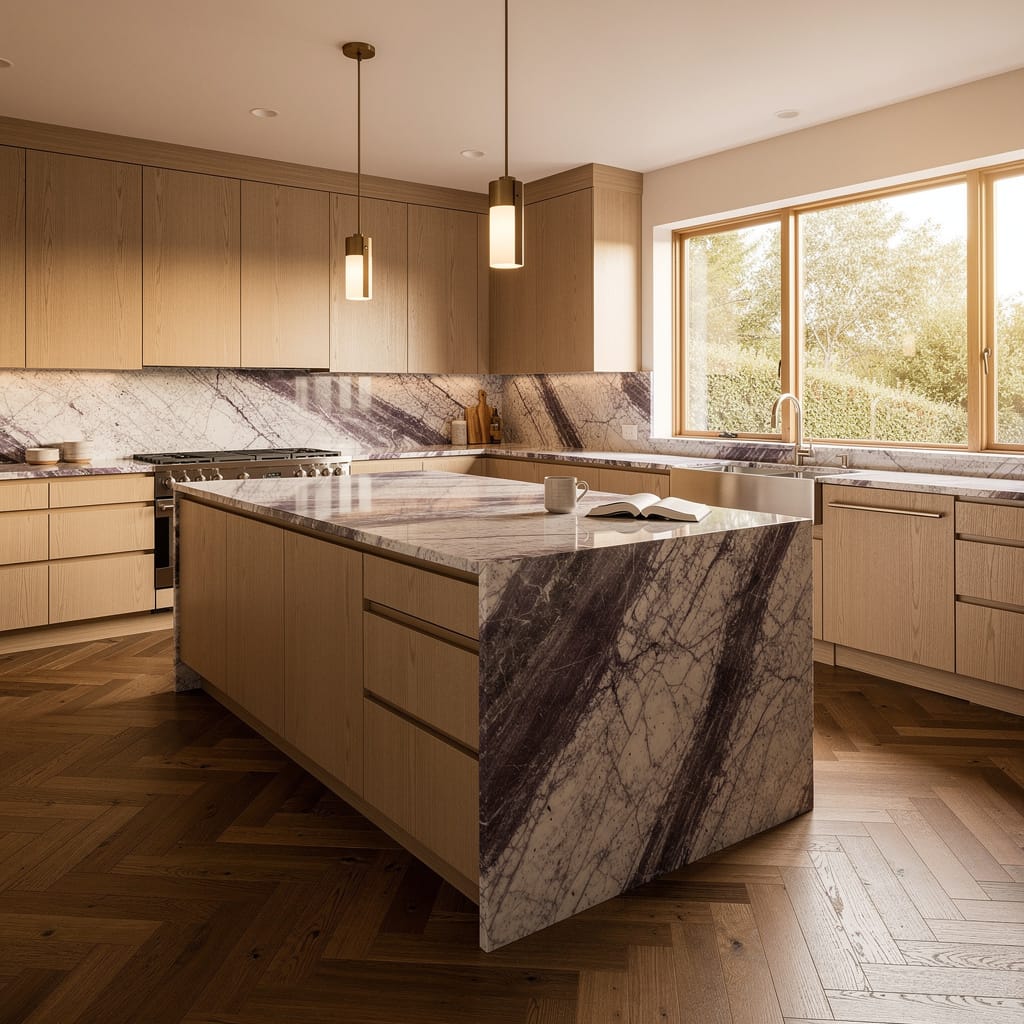
Calacatta Viola marble—with its dramatic purple and grey veining on a warm white base—has become one of the most requested stones in Silicon Valley. When book-matched across a waterfall island, it creates an art-piece effect that anchors the entire kitchen. Our team works with local slab yards in the South Bay to hand-select every slab, ensuring the veining pattern tells a coherent story across all visible faces.
4. Leathered and Honed Finishes Over High Polish
Polished countertops aren't going away, but the fastest-growing finish choice in 2026 is leathered (also called brushed)—a soft, tactile surface that hides fingerprints, water spots, and minor imperfections beautifully. It pairs perfectly with other textured elements trending in Bay Area kitchens: hand-applied plaster walls, plaster range hoods, fluted cabinet details, and zellige tile backsplashes.
5. Concrete and Microcement Surfaces
For homeowners drawn to wabi-sabi and organic minimalism, poured-in-place microcement countertops are gaining traction. They're seamless, completely customizable in color, and develop a gentle patina over time. The trade-off is that they require sealing every 6–12 months and can micro-crack. We've done several microcement applications in Mountain View and Campbell kitchens that look stunning—but they're not for everyone.
6. Integrated Sinks and Drainage Grooves
Especially with Dekton and porcelain slab countertops, integrated sinks carved directly from the surface material are a sleek 2026 option. No seam between counter and basin means easier cleaning and a more monolithic look. Paired with an induction cooktop (another major 2026 trend) and integrated finger-pull cabinetry, this creates a kitchen that feels almost sculptural.
Is Quartzite Better Than Quartz for Kitchen Countertops?
This is one of the most common questions I hear during initial design meetings, and the confusion is understandable—the names are almost identical. But quartzite and engineered quartz are completely different materials, and in 2026, the gap in desirability is widening.
Quartzite is a natural stone formed when sandstone is subjected to extreme heat and pressure deep within the earth. It's quarried in slabs, just like granite or marble. Each piece is unique. It registers 7–8 on the Mohs hardness scale, making it harder than granite and dramatically harder than marble. It's heat resistant, scratch resistant, and when properly sealed once a year, highly stain resistant.
Engineered quartz (brands like Caesarstone, Cambria, Silestone, and MSI) is a manufactured product: roughly 90–94% ground natural quartz bound together with polyester resins and pigments. It's consistent, low-maintenance, and available in hundreds of colors and patterns—many designed to mimic marble or concrete.
So why is quartzite gaining ground? Three reasons:
- Authenticity: In 2026, Bay Area homeowners increasingly value real, natural materials. Rift-cut white oak, natural stone veneer, unlacquered brass, herringbone wood floors—these are all part of a broader movement toward honest materiality. Quartzite fits perfectly; engineered quartz, while practical, can feel synthetic by comparison.
- Heat performance: You can set a hot pan directly on quartzite without damage. Engineered quartz can discolor or crack with direct heat because of its resin content. With induction cooktops becoming standard in premium Bay Area kitchens, this matters less than it used to—but it's still a factor.
- Unique beauty: No two quartzite slabs look the same. The depth, translucency, and veining patterns in stones like Taj Mahal quartzite or Cristallo quartzite have a quality that engineered products can approximate but never truly replicate.
That said, engineered quartz remains an excellent choice for homeowners who want zero maintenance, a $65–$130/sq ft price point, and consistent aesthetics. Brands like Cambria (made in the USA) and Caesarstone offer sophisticated colorways that pair beautifully with Kohler fixtures, Thermador appliances, and DalTile backsplashes. For secondary kitchens, guest bathrooms, and ADU kitchens where budget efficiency matters, quartz is still hard to beat.
How to Choose the Right Countertop for Your Silicon Valley Kitchen Remodel
After walking hundreds of homeowners through this decision across San Jose, Sunnyvale, Santa Clara, and beyond, I've distilled the selection process into five honest questions:
1. How do you actually use your kitchen?
If you cook intensely—multiple meals a day, lots of prep, kids helping—prioritize hardness and stain resistance. Quartzite or Dekton will serve you better than marble. If your kitchen is more for entertaining and light cooking, marble's beauty may be worth the trade-offs.
2. Can you live with imperfection?
Marble etches when exposed to acidic foods (lemon juice, wine, tomato sauce). Over time, a marble countertop develops a patina that some homeowners love and others can't stand. I always tell clients: if a water ring on a coffee table bothers you, marble is not your material.
3. What's your total kitchen budget?
Countertops are a significant investment, but they shouldn't consume a disproportionate share of your budget. In a $150,000–$250,000 Bay Area kitchen remodel, I typically recommend allocating $10,000–$20,000 for countertops. Spend the rest on great cabinetry, proper lighting, premium appliances (Miele, Thermador, Wolf), and excellent craftsmanship.
4. Are you renovating for yourselves or for resale?
If resale is on the horizon (within 3–5 years), a universally appealing material like white/grey quartzite or high-end engineered quartz offers the safest ROI. If this is your forever home, follow your heart—whether that leads to dramatic Calacatta Viola marble or moody green soapstone.
5. Do you want indoor-outdoor continuity?
If your remodel includes outdoor living spaces or a pass-through window to a patio kitchen, Dekton is the only premium surface I recommend for exterior use. Marble and quartzite can be damaged by prolonged UV exposure and freeze-thaw cycling (less of an issue in the Bay Area, but UV degradation is real).
Our team at Barcci Builders uses 3D design rendering to show you exactly how each countertop material will look in your actual kitchen layout, with your chosen cabinetry and lighting, before a single slab is cut. This is especially valuable when you're comparing two or three materials and need to see them in context.
Bay Area Countertop Installation: Timeline, Permits, and What to Expect
Once you've selected your material, here's what the countertop installation process looks like in a typical Bay Area kitchen remodel:
Timeline from Selection to Installation
- Slab selection at the yard: 1–2 visits (we accompany every client). Major slab suppliers we work with are located in the South Bay and Peninsula.
- Template measurement: Done after cabinets are fully installed. A laser template takes 2–4 hours depending on kitchen complexity.
- Fabrication: Typically takes 7–14 business days. Waterfall edges, mitered edges, and complex cutouts extend this timeline.
- Installation day: 4–8 hours for most kitchens. The countertop team arrives with the finished pieces and sets them on the cabinets, leveling, shimming, and seaming as needed. Undermount sinks (like Kohler Whitehaven or Blanco Silgranit) are clipped and sealed during this visit.
Total timeline from slab selection to cooking on your new countertops: typically 3–5 weeks.
Do You Need Permits for Countertop Replacement in Santa Clara or San Mateo County?
A countertop-only swap—removing old counters and installing new ones on existing cabinets—does not require a building permit in Santa Clara County or San Mateo County. However, if you're relocating plumbing (moving the sink), adding electrical (under-cabinet outlets), or altering the layout, you will need permits. For any full kitchen remodeling project in Los Gatos, Saratoga, Cupertino, or other Bay Area cities, our team handles all permit applications, inspections, and municipal coordination.
Seaming: The Detail That Separates Good from Great
In luxury countertop installations, seam placement matters enormously. Our fabrication partners use CNC machinery to achieve seams as tight as 1/64 of an inch, color-matched with epoxy. We plan seam locations during the 3D design phase so they fall in the least visible spots—never across the main sight line of an island. This level of attention is what separates a builder who installs 5 kitchens a year from a team like ours that has completed 116+ projects.
Frequently Asked Questions
What is the most durable kitchen countertop material in 2026?
In 2026, Dekton (sintered stone) and quartzite are the most durable kitchen countertop materials available. Dekton rates an 8 on the Mohs hardness scale, has zero porosity, and is resistant to heat, UV light, scratches, and stains—making it virtually indestructible in a kitchen environment. Quartzite rates 7–8 on the Mohs scale and offers similar scratch and heat resistance, though it does require annual sealing to maintain stain resistance. Both significantly outperform marble (Mohs 3–4) and even engineered quartz in overall durability.
How much does a quartzite countertop cost per square foot in the Bay Area?
Quartzite countertop costs in the Bay Area range from $100 to $200 per square foot installed in 2026. This includes the slab, fabrication, and professional installation. Premium varieties like Taj Mahal, Sea Pearl, and Cristallo fall in the $120–$180 range, while exotic or rare quartzites can exceed $200/sq ft. For an average 40-square-foot island, expect to pay $4,000–$8,000 installed. Bay Area fabrication and installation labor runs higher than national averages due to the cost of skilled tradespeople in Silicon Valley.
Is Dekton worth it for kitchen countertops?
Dekton is absolutely worth it for homeowners who prioritize low maintenance, durability, and design versatility. At $85–$175 per square foot installed in the Bay Area, it sits in a similar price range as quartzite but requires zero sealing, never etches from acidic foods, and is the only premium countertop material suitable for both indoor and outdoor use. Colors like Dekton Kreta (a warm limestone look) and Dekton Eter (a soft concrete aesthetic) fit perfectly with 2026's earthy, organic design trends. The main trade-off is that it's a manufactured product—it lacks the unique, one-of-a-kind veining you get with natural stone.
Does marble stain easily and is it a bad choice for a kitchen?
Marble is porous and will etch when exposed to acidic substances like lemon juice, vinegar, wine, and tomato sauce. Over time, it develops a patina of light marks and subtle staining that some homeowners find beautiful and others find frustrating. Marble is not a bad choice for a kitchen—it's been used in kitchens across Europe for centuries—but it requires a specific mindset. At Barcci Builders, we often recommend using marble on the island as a statement piece and pairing it with Dekton or quartzite on perimeter counters where most cooking happens. Proper sealing every 6–12 months with a high-quality impregnating sealer (like StoneTech BulletProof) significantly reduces staining risk.
What is the difference between quartzite and quartz countertops?
Quartzite is a natural stone mined from the earth—each slab is unique with natural veining and patterns. It's extremely hard (7–8 on the Mohs scale) and heat resistant. Engineered quartz is a manufactured product made from approximately 90% ground quartz crystals bound with polyester resins and pigments—it's consistent, non-porous, and available in many colors. In 2026, quartzite is surging in popularity for luxury Bay Area kitchens because it delivers the authenticity and warmth of natural stone with durability that rivals granite. Engineered quartz (Caesarstone, Cambria, Silestone) remains an excellent mid-range option at $65–$130 per square foot installed.
What countertop color is trending for kitchens in 2026?
The biggest countertop color trend in 2026 is a shift away from stark white toward warm, earthy tones. Warm whites with honey or taupe veining (like Taj Mahal quartzite), soft greiges, warm creams, and even stones with subtle blush or green undertones are dominating Bay Area kitchen design. Calacatta Viola marble—with its distinctive purple-grey veining on a warm white base—is one of the most requested premium stones in Silicon Valley. These warm stone tones pair beautifully with rift-cut white oak cabinetry, unlacquered brass hardware, zellige tile backsplashes, and the organic, layered aesthetic defining the best kitchens of 2026.
How long does it take to install new kitchen countertops in Silicon Valley?
From slab selection to completed installation, the kitchen countertop process typically takes 3–5 weeks in Silicon Valley. This includes 1–2 slab yard visits, laser templating after cabinets are installed (2–4 hours), fabrication (7–14 business days depending on complexity), and installation day (4–8 hours). Waterfall edges, book-matching, and complex cutouts can extend fabrication by an additional week. If you're doing a full kitchen remodel with new cabinets, countertop templating can't begin until cabinetry installation is 100% complete—so your total project timeline will be longer, typically 10–16 weeks for a comprehensive Bay Area kitchen renovation.
What is the best countertop for an outdoor kitchen in the Bay Area?
Dekton by Cosentino is the best countertop for outdoor kitchens in the Bay Area. It's the only premium surface that is UV-stable (won't fade in California sun), frost-proof, heat-resistant, and completely non-porous. Natural stones like granite and quartzite can be used outdoors but may discolor with prolonged UV exposure and require more frequent sealing. Marble should never be used in outdoor kitchen applications. For Bay Area outdoor kitchens and BBQ islands, we typically specify Dekton in 20mm thickness with colors like Kreta, Bergen, or Trilium, paired with cedar cladding or natural stone veneer on the base structure.