Why 1,200 Square Feet Is the Magic Number for Bay Area ADUs
When homeowners in Los Gatos, Saratoga, and across Silicon Valley ask me where to start with an ADU, my first question is always: what do you need this space to actually do? The answer to that question determines everything — but what I've learned from over 116 completed projects is that 1,200 square feet is almost always the sweet spot for Bay Area lots.
Here's the practical reason: California's ADU law (AB 68 and subsequent legislation) set 1,200 sq ft as the maximum allowable size for a detached ADU on most single-family lots. That ceiling isn't arbitrary — it's large enough to build a genuinely comfortable 2-bedroom, 2-bath home, yet small enough to fit on a typical Silicon Valley lot without consuming the entire rear yard. Every square foot above that threshold requires a variance that most cities won't grant. So the real design challenge isn't what's technically possible — it's how to make every square foot below that limit feel generous, functional, and worth the investment.
In my experience, the difference between a cramped ADU and a spacious one has almost nothing to do with total square footage. It has everything to do with how the floor plan is organized: where natural light enters, how circulation flows, where storage is tucked, and whether the kitchen and living areas feel connected to outdoor space. A poorly planned 1,100 sq ft ADU can feel like a hotel room. A well-planned 700 sq ft studio can feel like a boutique apartment.
This guide breaks down the ADU floor plan layouts we build most often for Bay Area clients, what each configuration actually costs, and how to choose the right one for your specific lot and goals.
The 5 ADU Floor Plan Layouts That Actually Work on Bay Area Lots
Not all floor plans translate well to the constraints of a Silicon Valley backyard. Narrow side yards, setback requirements, heritage trees, and slope — these are real obstacles we navigate on nearly every project. Here are the five layouts I recommend most often, and why each one works:
1. The Open-Plan Studio (400–550 sq ft)
The studio ADU is the most cost-efficient build per square foot and the fastest to permit. We design these with a fully open living, dining, and kitchen area, a full bathroom, and a sleeping alcove separated by a half-wall, built-in storage unit, or curtain track. On lots in Campbell and San Jose where rear yard space is tight, a footprint of roughly 20' × 25' fits cleanly within setback requirements while still delivering a livable space. Current design trends we're incorporating include microcement floors, integrated finger-pull cabinetry, and zellige tile backsplashes that give a small space huge visual personality without adding square footage.
2. The 1-Bedroom / 1-Bath (550–750 sq ft)
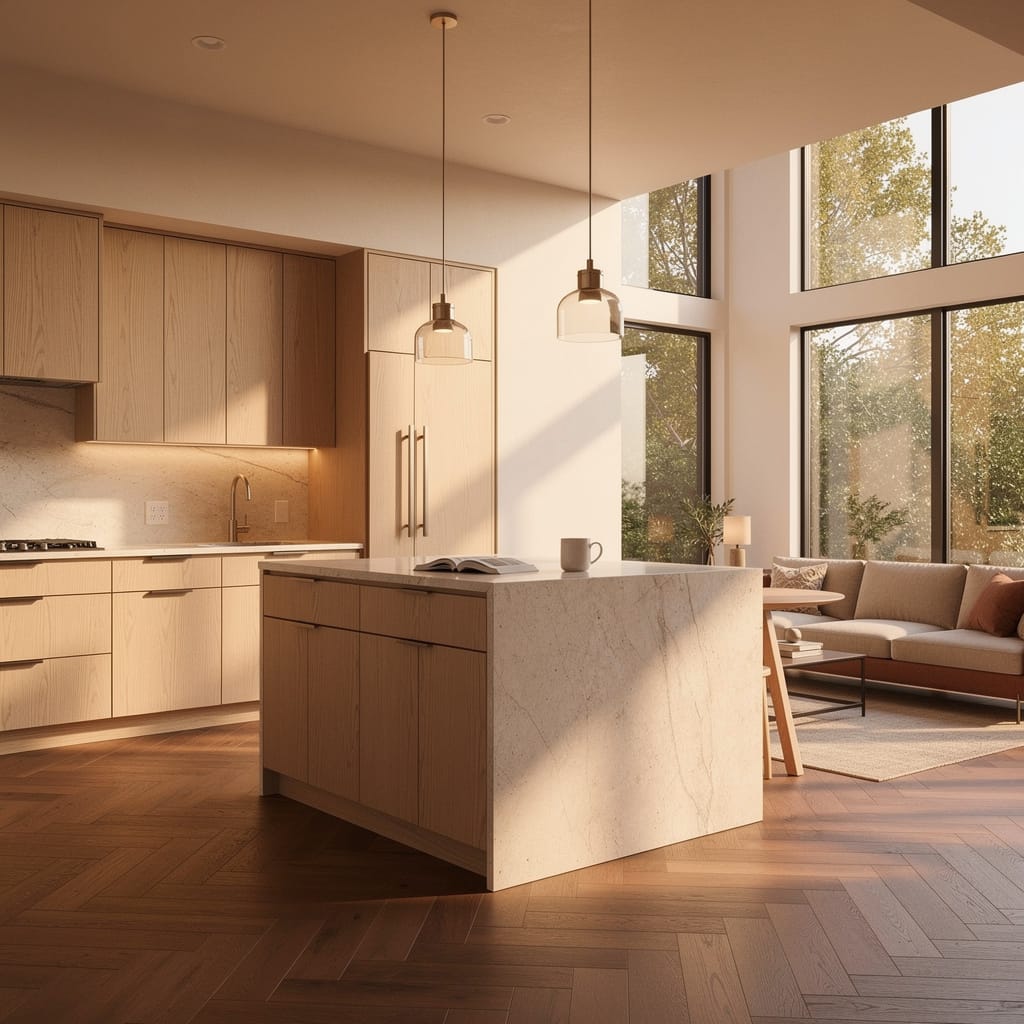
This is our most-requested layout for rental income ADUs. A true bedroom with a closet, a full bath, an open kitchen and living zone, and — critically — some form of outdoor connection, whether a small patio, French doors, or a covered deck. At this size, we have room to incorporate rift-cut white oak flooring in a herringbone pattern, plaster range hoods, and Dekton or quartzite countertops that make the kitchen feel custom and high-end without overwhelming the space. This layout rents for $2,800–$4,200/month across most of Santa Clara County.
3. The 1-Bedroom + Flex Room (750–950 sq ft)
One of the smartest configurations for multigenerational households — a primary bedroom, a flex room that works as an office, guest room, or nursery, one full bath (sometimes 1.5), and a well-proportioned open living and kitchen area. We've built this layout for families in Monte Sereno and Los Altos who want to house an aging parent without giving up a home office. The flex room typically runs 100–130 sq ft, large enough for a Murphy bed, a built-in desk, or both.
4. The 2-Bedroom / 1-Bath (850–1,000 sq ft)
Two true bedrooms with closets, a shared full bath, and an open kitchen-living-dining zone. This plan works well for young families using the ADU for extended family members or for maximizing rental yield. The layout challenge here is circulation — getting from the front entry to both bedrooms without cutting through the main living area. We solve this with a short dedicated hallway that also houses the washer/dryer stack and linen storage.
5. The Full 2-Bedroom / 2-Bath (1,000–1,200 sq ft)
This is the layout that most closely mirrors a standalone apartment or junior home. Two bedrooms, two full baths (one en suite to the primary), a kitchen with room for an island or peninsula, a proper dining area, and a living room that feels distinct from the kitchen. At this scale, we have room to do real architecture — fluted details on the kitchen island, hand-applied plaster walls in the main living area, unlacquered brass fixtures, and natural stone veneer on an exterior accent wall. These ADUs appraise for $650,000–$950,000 in neighborhoods like Palo Alto, Menlo Park, and Atherton.
ADU Construction Costs in 2026: What Each Layout Actually Costs in the Bay Area
I want to give you real numbers — not the $150/sq ft figures you'll see on national cost calculators that have nothing to do with building in Santa Clara or San Mateo County. Bay Area ADU construction costs in 2026 reflect local labor rates, permit fees, utility connection costs, and material quality. Here's what we're actually quoting:
- Studio ADU (400–550 sq ft): $180,000–$260,000 all-in, including permits, foundation, framing, MEP, finishes, and site work. Average cost per sq ft: $380–$480.
- 1-Bedroom / 1-Bath (550–750 sq ft): $240,000–$360,000. At this range, clients can afford quality finishes — Calacatta Viola marble in the bath, induction cooktop, custom millwork.
- 1-Bedroom + Flex Room (750–950 sq ft): $320,000–$430,000. The per-square-foot cost drops slightly as fixed costs (foundation, utility connections, permits) are amortized across more square footage.
- 2-Bedroom / 1-Bath (850–1,000 sq ft): $370,000–$470,000.
- 2-Bedroom / 2-Bath (1,000–1,200 sq ft): $420,000–$580,000+, depending on finishes. High-end projects with plaster walls, Dekton surfaces, rift-cut white oak floors, and a custom kitchen can reach $650,000.
What drives costs up beyond these ranges? Sloped lots requiring engineered foundations add $30,000–$60,000. Upgrading an undersized main panel to support an ADU adds $8,000–$18,000. Underground utility work in older neighborhoods can add $20,000–$40,000. If you're building in a fire hazard zone (common in the Los Gatos hills, Saratoga, and Woodside), fire-resistive framing and roofing requirements add 8–14% to the structural budget.
Our ADU and home addition services include a thorough site assessment before we quote anything — because an ADU on a flat Campbell lot and an ADU on a hillside lot in Woodside are completely different projects cost-wise, even if the floor plans are identical.
How Bay Area City Regulations Shape Your ADU Floor Plan Choices
One of the most common mistakes I see homeowners make is downloading a generic ADU floor plan from the internet and then discovering it doesn't comply with their city's specific setback, height, or coverage requirements. California state law has done a lot to streamline ADU permitting since 2020, but local jurisdictions still have meaningful control over what gets built and where.
Here are the key regulatory variables that affect floor plan decisions across our service area:
- Setbacks: State law allows cities to require a maximum 4-foot rear and side setback for detached ADUs. However, some cities still enforce stricter setbacks for ADUs over a certain height. A floor plan that works on a 7,500 sq ft lot in Cupertino may not fit within setbacks on a narrower lot in Sunnyvale.
- Maximum height: Most cities allow 16 feet for a single-story detached ADU and up to 25 feet for a two-story, though this varies. In hillside overlay zones in Los Gatos and Saratoga, height is often more restricted to preserve views and neighborhood character.
- Lot coverage: Many cities limit the percentage of a lot that can be covered by structures. A 1,200 sq ft ADU on a small lot might push you over coverage limits, forcing you to reduce the footprint or build up.
- Parking: State law eliminated parking requirements for ADUs within half a mile of public transit. But in areas of San Mateo County and Hillsborough, parking requirements still apply in some configurations.
- Fire sprinklers: Detached ADUs under 1,200 sq ft are generally exempt from automatic fire sprinkler requirements under California building code, but check with your local fire authority — some jurisdictions have adopted stricter local amendments.
We handle permit submissions in all the cities we serve, and we've developed working relationships with planning departments across Santa Clara, San Mateo, and Santa Cruz Counties. Our 3D design and rendering process lets us test multiple floor plan configurations against your specific parcel's constraints before we ever submit a permit application — saving weeks of back-and-forth with the planning department.
Interior Design Strategies That Make Small ADU Floor Plans Feel Larger
The floor plan is the skeleton. What makes an ADU genuinely livable — and genuinely worth the investment — is how the interior is designed to maximize every square foot. After building ADUs across Mountain View, Fremont, Burlingame, and dozens of other Bay Area cities, here are the interior strategies that consistently deliver the biggest impact in small spaces:
Use Vertical Space Aggressively
In a 700 sq ft ADU, floor-to-ceiling cabinetry isn't a luxury — it's a space strategy. We design kitchens with upper cabinets that run to the ceiling (often with integrated finger pulls instead of visible hardware), bathrooms with recessed niches instead of freestanding shelving, and bedrooms with built-in wardrobes that eliminate the need for a separate walk-in closet.
Borrow Light from Every Source
Skylights, transom windows above doors, and glass panels in interior walls are all tools we use to move natural light deeper into an ADU floor plan. In a 1-bedroom ADU where the bedroom faces north or is interior-adjacent, a strategically placed skylight over the bath or hallway can transform what would otherwise be a dark corner into a bright, welcoming space.
Design Outdoor Connection Into the Plan
A 10' × 12' covered patio off the main living area effectively extends the ADU's usable space by 120 sq ft — at a fraction of the cost of adding interior square footage. We almost always incorporate exterior and landscaping design into our ADU projects, because a small patio with cedar cladding on the ADU's exterior wall, a simple outdoor dining area, and good perimeter planting makes the whole property feel cohesive and elevated.
Choose Finishes That Expand Space Visually
In 2026, the finishes that work hardest in small ADU spaces include: large-format stone-look tile or microcement floors (fewer grout lines = less visual fragmentation), warm earthy tones on walls rather than stark white (counterintuitively, warm colors make spaces feel more enveloping and intentional), unlacquered brass hardware that ages with character and adds warmth, and fluted glass on cabinet inserts that suggests depth without visual noise. Zellige tile in a kitchen or bath — with its handmade variation and organic texture — adds personality to a small space without requiring much real estate.
Plan Storage as Architecture, Not an Afterthought
In every ADU we build, storage is designed into the floor plan from day one — not squeezed in at the end. That means under-stair storage if the ADU has a loft, bench seating with lift-top storage at the entry, and a linen closet that doubles as the mechanical room for the tankless water heater and electrical panel. Our whole-house remodel methodology translates directly to ADU design: every square foot has to earn its place.
Attached vs. Detached ADUs: Which Floor Plan Approach Is Right for Your Property?
Floor plan strategy changes significantly depending on whether you're building a detached ADU in the rear yard, an attached ADU connected to the main house, or converting an existing garage. Each configuration has its own design logic, cost structure, and timeline.
Detached ADU (New Construction)
Maximum design freedom. You control orientation, window placement, outdoor access, and the relationship to the main house and garden. These projects take 10–16 months from design through occupancy in most Bay Area cities. They're also the most expensive, because you're building a complete structure — foundation, framing, roofing, and all MEP systems from scratch. But they also create the most value and the highest rental income because they offer complete privacy from the main house.
Attached ADU (Addition to Existing Home)
An attached ADU shares at least one wall with the main house. This reduces foundation and exterior wall costs and can accelerate permitting in some cities. The floor plan challenge is acoustic and visual separation — ensuring the ADU residents and main house residents truly feel independent from each other. We design these with dedicated exterior entrances, sound-insulated shared walls (often double-stud or staggered-stud construction), and separate utility metering where local rules allow.
Garage Conversion ADU (JADU or Standard ADU)
Converting an attached or detached garage is the fastest and most affordable path to an ADU — typically $120,000–$220,000 for a full conversion with quality finishes. The floor plan constraint here is the existing footprint: most single-car garages are 12' × 22' (264 sq ft), and most two-car garages are 20' × 22' (440 sq ft). We can often expand the footprint slightly with a bump-out addition, but the existing slab and walls set the basic parameters. Garage conversions typically permit in 4–8 months and are complete within 6–9 months of permit approval.
Regardless of which ADU type fits your property, the design process starts the same way: a site visit, a conversation about how you plan to use the space, and a realistic assessment of what your lot, your city's regulations, and your budget actually support. We've completed this process on hundreds of properties across the Bay Area, and we've never had two that were exactly alike.
ADU Project Timeline: What to Expect from Design Through Move-In
One of the first questions every client asks is: how long is this going to take? The honest answer is that a well-managed ADU project from initial design through final sign-off and move-in takes 14–22 months for a detached new-construction ADU in most Bay Area cities. Here's how that timeline breaks down:
- Months 1–2: Discovery, site assessment, design kickoff. We assess your lot, review zoning and HOA restrictions (if applicable), discuss floor plan options, and begin schematic design. Our 3D rendering process gives you a photorealistic view of the completed ADU before we finalize plans.
- Months 2–4: Design development and permit documentation. We finalize the floor plan, structural engineering, Title 24 energy compliance, and all permit drawings. This is where most of the design decisions — finishes, cabinetry, fixtures — are locked in.
- Months 4–8 (sometimes longer): Permit review and approval. This is the most variable part of the timeline and the one least within our control. Cities like San Jose and Campbell have been improving their ADU permit processing times, but plan check in some jurisdictions still takes 3–5 months. We submit complete, code-compliant packages to minimize correction cycles.
- Months 8–14: Construction. Foundation, framing, roofing, rough MEP (mechanical, electrical, plumbing), insulation, drywall, finishes, fixtures, and site work. A well-organized construction phase on a standard ADU runs 5–7 months.
- Months 14–16+: Final inspections, punch list, and occupancy permit. We coordinate all final inspections, address any punch list items, and deliver the occupancy permit — the document that allows someone to legally live in the ADU.
Garage conversions and attached ADUs tend to run faster — 10–14 months total is realistic for these configurations. Projects in cities with streamlined ADU permitting, like those in Santa Clara County that have adopted the county's pre-approved ADU plan program, can sometimes compress the permit phase significantly.
If you're planning to rent the ADU, build rental income projections with a 16-month buffer to be conservative. If you're building for family — a parent moving in, an adult child returning — communicate that timeline clearly and plan the transition accordingly. Rushing construction to hit an arbitrary move-in date is one of the fastest ways to compromise quality and create problems that take years to address.
Frequently Asked Questions
What is the maximum ADU size allowed on a single-family lot in California?
California state law (Government Code Section 65852.2) sets the maximum size for a detached ADU at 1,200 square feet. For attached ADUs, the limit is typically 50% of the primary dwelling's square footage, up to 1,200 sq ft. Junior ADUs (JADUs), which are created within the existing walls of the primary structure, are capped at 500 square feet. Some cities have additional local restrictions, so it's worth verifying the exact limits with your city's planning department or with a contractor who knows your jurisdiction. In our experience across Los Gatos, Saratoga, Campbell, and San Jose, the 1,200 sq ft cap is rarely the binding constraint — lot coverage, setbacks, and height limits usually define the actual buildable envelope before you reach the size cap.
How much does it cost to build an ADU in the Bay Area in 2026?
Bay Area ADU construction costs in 2026 range from approximately $180,000 for a modest studio ADU to $580,000 or more for a fully appointed 2-bedroom/2-bath ADU at 1,200 square feet with high-end finishes. The per-square-foot cost typically runs $380–$500 for standard finishes and $480–$600+ for luxury finishes (rift-cut white oak floors, Dekton countertops, Calacatta Viola marble, hand-applied plaster walls, custom millwork). These figures include design, permits, site work, foundation, framing, MEP systems, insulation, drywall, and finishes — not just construction labor and materials. Garage conversions are significantly less expensive, typically running $120,000–$220,000. Sloped lots, fire hazard zones, panel upgrades, and underground utility work are the most common cost drivers beyond the base building cost.
Which ADU floor plan generates the most rental income in the Bay Area?
Based on current rental market data in Santa Clara and San Mateo Counties, a 2-bedroom/1-bath or 2-bedroom/2-bath ADU generates the highest gross rental income — typically $3,500–$5,500/month depending on location, finishes, and whether utilities are included. However, the 1-bedroom/1-bath layout often provides the best return on investment when you factor in the lower construction cost. A well-finished 1-bedroom ADU costing $300,000 renting at $3,200/month in a city like Sunnyvale or Mountain View can yield a stronger cap rate than a 2-bedroom ADU costing $500,000 renting at $4,500/month. Location matters enormously — ADUs in Palo Alto, Menlo Park, and Atherton command the highest rents in the region, often 20–35% above comparable units in South San Jose or Fremont.
Do I need an architect for an ADU, or can a design-build contractor handle everything?
For most residential ADU projects in California, you are not legally required to hire a licensed architect — a licensed general contractor with design capabilities (or a structural engineer for stamping drawings) can handle the full scope. At Barcci Builders, we operate as a design-build firm, which means we manage design, engineering, permit submission, and construction under one roof. This approach eliminates the coordination gaps that arise when an architect hands off plans to a separate general contractor, and it typically reduces both cost and timeline. That said, for ADUs with significant architectural complexity — unusual structural requirements, hillside sites, or high-end design aspirations — we collaborate with licensed architects as part of our team. The key is working with someone who understands both the design vision and the construction realities of building in the Bay Area.
Can I build an ADU if my property has a homeowners association (HOA)?
California Civil Code Section 4751 (effective January 1, 2022) prohibits HOAs from unreasonably restricting ADU construction on single-family lots. HOAs can still enforce reasonable standards related to aesthetics, colors, and materials, but they cannot outright ban ADUs or impose conditions that effectively make them infeasible. In practice, this means HOAs in communities like parts of Saratoga, Los Altos Hills, and some gated communities in the Los Gatos area can still require design review and approval — but they must approve compliant projects within a reasonable timeframe. We've navigated HOA design review processes for numerous clients and have found that submitting high-quality 3D renderings and a materials board significantly accelerates approvals. If your HOA is pushing back on a legitimate ADU project, California's ADU statutes give you meaningful legal leverage.
How does an ADU affect my property taxes in California?
Under California's Proposition 13 framework, adding an ADU triggers a partial reassessment — meaning only the value of the new ADU addition is assessed at current market value. The existing home's assessed value is not recalculated. For a new detached ADU, this typically adds $2,500–$6,000 per year in property taxes, depending on the assessed value of the improvement and your county's tax rate (roughly 1.1–1.3% of assessed value in most Bay Area counties). Importantly, the rental income potential of the ADU — which could be $36,000–$60,000 per year — vastly exceeds the incremental property tax burden. Additionally, if you are over 55, have a severe disability, or are a disaster victim, you may qualify for base year value transfer protections that limit the tax impact further. We always recommend consulting a CPA familiar with California property tax law before making final financial projections.
What's the difference between a detached ADU and a JADU?
A Junior ADU (JADU) is an ADU created entirely within the existing footprint of the primary residence — typically a converted bedroom, basement space, or attached garage. JADUs are capped at 500 square feet, must have an independent entrance, and must include at least an efficiency kitchen. They can share a bathroom with the main house. JADUs are the fastest and most affordable path to adding a legal rental unit — often $80,000–$150,000 total — and they typically trigger a simpler permit review process than a detached ADU. The tradeoff is privacy: because a JADU is within the main house, there is more acoustic and functional overlap with the primary residence. A detached ADU is a completely separate structure — its own foundation, walls, roof, and systems — which provides full privacy for both the ADU occupant and the main house residents. For multigenerational households where an aging parent wants independence, or for maximizing rental income, a detached ADU almost always delivers more value despite the higher upfront cost.
How long does ADU permitting take in Santa Clara County cities?
Permit timelines vary significantly by city. In our experience, San Jose has improved its ADU permit processing considerably and now typically completes initial plan check in 6–10 weeks for straightforward projects. Campbell and Los Gatos run 8–14 weeks for initial plan check. Cupertino and Sunnyvale have generally efficient processes, often in the 8–12 week range. Mountain View and Palo Alto can run longer — 12–20 weeks — for initial review, particularly if the project requires environmental or design review. Cities in San Mateo County like Burlingame and San Mateo city tend to run 10–16 weeks. These are initial plan check times; corrections, resubmittals, and back-and-forth with planning can extend the total permit phase to 4–8 months in many cases. The single most effective way to minimize permit delays is to submit a complete, code-compliant permit package the first time — which requires working with a team that knows local plan check requirements and common correction triggers for each jurisdiction.